
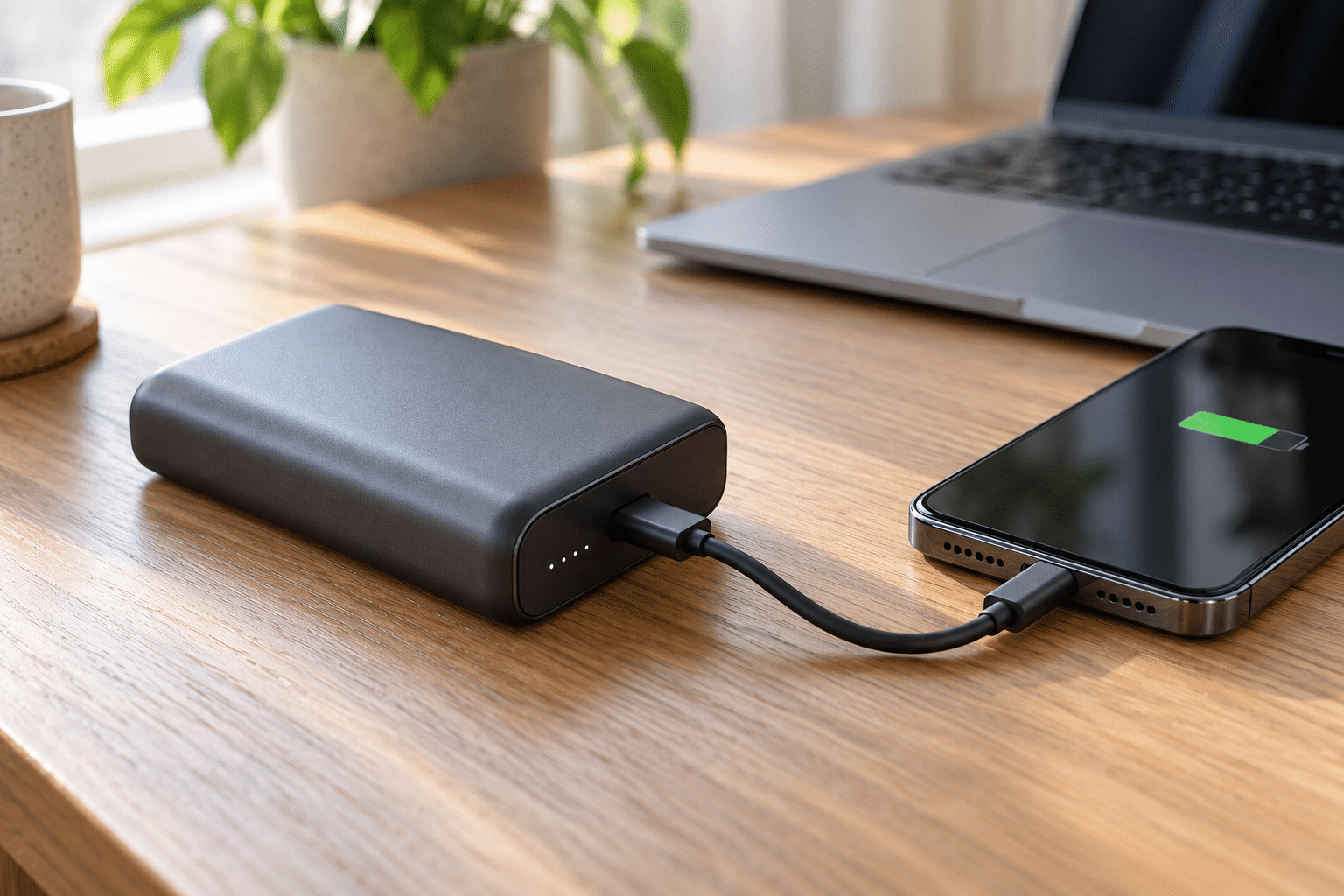
Editorial note: This buyer’s checklist replaces an earlier AI-assisted list of “best” products. TechNexts has not tested the models named in that version, so the rankings, prices and charging claims have been removed. Check current specifications with the maker before buying.
A portable charger is useful only if its capacity, ports and output suit your devices. The label on the product and the device maker’s charging specifications matter more than a headline “mAh” number. This guide shows what to compare and how to avoid a common travel surprise.
Start with the device, not the power bank
Write down the device model, its charging port and supported charging method. A phone may work with a modest USB-C output, while a laptop may require USB Power Delivery (USB PD) at a higher wattage. Check whether the laptop can charge through USB-C at all and the input power its maker recommends. If a power bank advertises a large total output, inspect the output of the individual port you will actually use, especially when two devices are connected.
Capacity: mAh and Wh answer different questions
Capacity is often advertised in milliamp-hours (mAh) at the battery cell’s nominal voltage. Watt-hours (Wh) describe energy and make it easier to compare packs, especially for travel. If the nominal voltage is given, a rough conversion is Wh = mAh × V ÷ 1,000. For example, 20,000 mAh at 3.7 V is about 74 Wh of stored energy. That is not the amount your phone receives: conversion losses, cable losses and charging behavior reduce delivered energy. Do not promise a specific number of full phone charges from mAh alone.
Prefer a clearly marked Wh rating on the battery or in the maker’s official specifications. Be cautious of a listing that omits the nominal voltage and Wh rating while claiming an implausibly high capacity in a tiny enclosure.
Match power and cable
| Question | Why it matters |
|---|---|
| Does the port support USB PD or the device’s required protocol? | A USB-C shape alone does not guarantee the charging mode. |
| What is the per-port output, and what changes when two ports are used? | Shared power can reduce each device’s charging rate. |
| Can the bank itself recharge at a practical input wattage? | A large bank may take much longer to refill with a low-power adapter. |
| Is the cable rated for the needed power? | The cable is part of the charging path, particularly for laptops. |
The USB Implementers Forum explains USB Power Delivery. Its certified product search and cable information can help verify a specific USB-IF certification or cable marking. A certification logo is useful when genuine; an unverified seller claim is not a substitute for the exact model’s specifications.
Flying with a power bank
In the United States, the FAA treats power banks as spare lithium-ion batteries: carry them in hand baggage, not checked baggage. A battery up to 100 Wh generally fits the FAA’s usual limit. For 101–160 Wh, airline approval is required and the FAA limits the number of larger spares. Batteries over 160 Wh are not allowed on passenger aircraft under this rule. Read the FAA PackSafe lithium-battery guidance before a trip, and check the airline and destination rules, which may differ or be stricter. If your carry-on is taken at the gate for checking, remove the power bank and keep it with you in the cabin.
A practical buying sequence
- Check the phone or laptop’s charging requirements on its official support page.
- Choose capacity based on the day you need to cover, then compare labeled Wh, weight and size.
- Verify the power bank’s per-port output, simultaneous output and recharge input in the model’s manual.
- Confirm cable rating and connector type. Account for any cable you must carry.
- For travel, check the printed Wh rating against current airline rules.
- Buy from a seller with clear warranty and return terms. Check for recalls and do not use a damaged or swollen pack.
Wireless magnetic charging can be convenient, but compatibility and speed vary by phone and accessory. The appropriate choice depends on your actual device and use, not a universal “best” award.
Sources
- FAA: PackSafe lithium batteries
- FAA: Airline passengers and batteries
- USB-IF: USB Power Delivery
- USB-IF: Certified product search
A label-reading example
Imagine two unbranded specification sheets. Pack A lists 10,000 mAh at 3.7 V and 20 W from one USB-C port. Pack B lists 20,000 mAh at 3.7 V and 65 W from one port, dropping to 45 W plus 15 W when two devices charge. The stored-energy calculations are 37 Wh and 74 Wh. Neither result predicts delivered charge count.
If the laptop manufacturer requires 65 W, Pack A does not meet that stated requirement and Pack B must be checked for the required USB PD voltage profile. Its shared-port mode also falls below 65 W. For a phone-only trip, Pack B’s extra weight may buy capacity you do not need. These are invented specifications for practice, not product recommendations.
Before flying, check the airline’s rules on carrying, storing and using the pack, not just its Wh rating. Keep its terminals protected and tell cabin crew if a battery overheats or swells. The FAA passenger guidance was checked October 5, 2026; airline and international restrictions can be stricter.
