
EdTech in 2026: AI Tutors Are Outperforming Human Ones — Now What?
EdTech in 2026: AI Tutors Are Outperforming Human Ones — Now What?
nnSal Khan saw it coming before almost anyone else. In 2023, the Khan Academy founder unveiled Khanmigo — an AI tutor built on GPT-4 that could explain concepts, work through problems with students, and adapt its teaching style in real time. Two years later, Khanmigo has over 4 million active users, and the results from controlled studies are striking: students using the AI tutor for just 30 minutes per week improved math scores by 20% compared to control groups. Not 20% over students with no help — 20% over students receiving traditional tutoring.
That study, published in the Journal of Educational Psychology in late 2025, sent shockwaves through the education technology industry. It validated what EdTech optimists had been arguing for years: personalized, AI-driven instruction can be dramatically more effective than one-size-fits-all classroom teaching, particularly for students who are behind grade level and need targeted remediation. And it raised uncomfortable questions about the future of human tutors, standardized curricula, and the $6.5 trillion global education industry.
Welcome to EdTech in 2026, where the technology is finally delivering on decades of promises — and the disruption is just beginning.
The AI tutor revolution
Khan Academy’s Khanmigo was first, but the market has exploded. Duolingo Max uses GPT-4 for conversational language practice that adapts to each learner’s level. Photomath (acquired by Google) solves math problems step by step using phone cameras, explaining the reasoning at each stage. Quizlet’s Q-Chat creates personalized study sessions that identify knowledge gaps and focus practice where it’s needed most. And dozens of startups — Synthesis, Studyforge, Mathpresso — are building AI tutors for specific subjects and age groups.
What makes these tools different from previous EdTech waves (MOOCs, iPad classrooms, gamified learning apps) is genuine personalization. Previous technologies delivered the same content to every student, just on a screen instead of paper. AI tutors assess what each student knows and doesn’t know, adapt the difficulty in real time, identify misconceptions and address them specifically, and maintain engagement through conversational interaction rather than passive video watching.
The evidence base is growing rapidly. A 2025 meta-analysis of 47 studies on AI-assisted learning found an average improvement of 0.4 standard deviations in learning outcomes — equivalent to moving a student from the 50th percentile to the 65th percentile. The effect was strongest for students who were already struggling, suggesting that AI tutors are most valuable as an equity tool, helping close achievement gaps rather than simply accelerating students who are already ahead.

EdTech platforms compared: 2026
| Platform | AI capability | Subject focus | Cost |
|---|---|---|---|
| Khan Academy + Khanmigo | GPT-4 tutor, Socratic questioning, progress tracking | Math, science, humanities (K-12) | Free / $44/yr for Khanmigo |
| Duolingo Max | GPT-4 conversation, roleplay, explanations | 40+ languages | $30/month |
| Coursera + AI Coach | Career guidance, course recommendations, assignment feedback | Professional / university level | $49-$79/month |
| Century Tech | Neuroscience-backed AI, knowledge mapping | STEM, English (K-12) | School licensing |
| Synthesis | AI-driven collaborative problem solving | Critical thinking, math (ages 6-14) | $149/month |
The cheating problem — and why it matters less than you think
The elephant in every EdTech conversation is cheating. ChatGPT can write essays, solve math problems, and generate code — and students are using it. A Stanford survey found that 60% of college students admitted to using AI on at least one assignment in 2025. Teachers are panicking. Anti-AI detection tools like Turnitin’s AI detector produce false positives at an alarming rate (one study found a 12% false positive rate, which is devastating when it means accusing innocent students of cheating).
But here’s the more nuanced view: the schools that are handling AI best aren’t trying to ban it — they’re redesigning assessments. Instead of take-home essays (trivially completable by AI), they’re using in-class presentations, oral examinations, project-based assessments, and — ironically — AI-assisted assignments where the goal is to demonstrate critical evaluation of AI-generated content. This approach treats AI as a tool to be mastered, not a threat to be eliminated, which is probably the right framing given that every future workplace will involve AI collaboration.
The most forward-thinking institutions are going further. Georgia Tech, MIT, and several UK universities now require students to document their AI interactions — showing which prompts they used, how they evaluated the output, and what they changed. This “AI transparency” approach teaches students to use AI critically while still demonstrating their own understanding.
VR and immersive learning: finally finding its niche
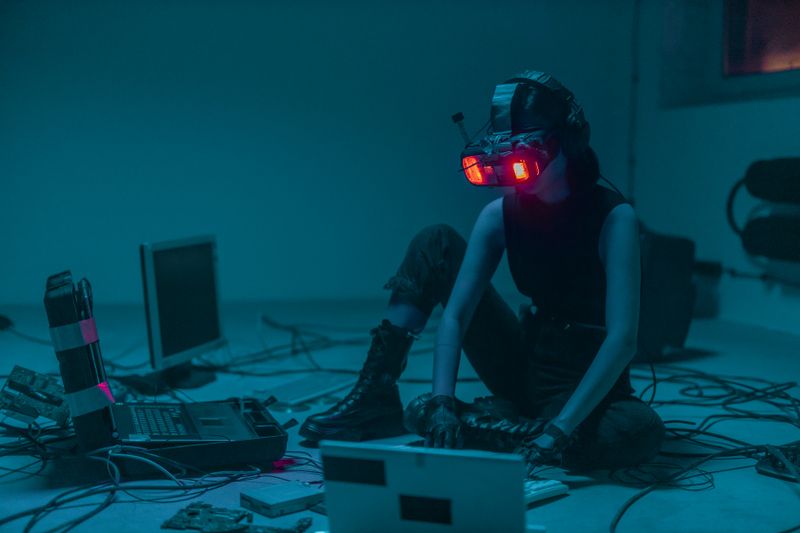
Remember when every tech company predicted that classrooms would go fully virtual? That didn’t happen for the same reason the metaverse didn’t happen — headsets are too expensive, too uncomfortable, and too isolating for daily classroom use. But VR has found specific educational niches where it’s genuinely irreplaceable.
Medical schools use VR to let students practice surgeries without risking patients. Chemistry programs simulate dangerous experiments in virtual labs. History classes use VR field trips to ancient Rome, the Apollo 11 command module, or the bottom of the Mariana Trench. And vocational training — welding, electrical work, heavy machinery operation — uses VR simulation to let students practice safely before touching real equipment.
The common thread is that VR works best when it provides experiences that are impossible, dangerous, or prohibitively expensive in the physical world. As a replacement for lectures or textbooks, it’s inefficient and expensive. As a supplement for experiential learning, it’s uniquely powerful. Schools that understand this distinction are getting real value from their VR investments. Schools that tried to replace traditional instruction wholesale have mostly abandoned the experiment.
What this means for the future of education
EdTech in 2026 is at an inflection point. AI tutors are demonstrably effective and increasingly affordable. Assessment methods are being redesigned around AI collaboration rather than AI prohibition. And the role of human teachers is shifting — from information delivery (which AI now does better) toward mentorship, motivation, social-emotional development, and the distinctly human skills that no algorithm can replicate.
The risk is equity. AI tutoring tools are most available to students in well-funded schools with good internet access — exactly the students who need them least. If EdTech widens the achievement gap rather than closing it, the technology will have failed its most important test. The organizations getting this right — Khan Academy with its free-first model, governments investing in broadband access, nonprofits distributing devices — understand that the technology only matters if everyone can access it. Whether the industry follows their lead will determine whether 2026’s EdTech revolution benefits all students or just the privileged few.
